Key Takeaways:
- Maricopa County’s extremely hard water deposits calcium and magnesium minerals deep into porous grout lines — and ordinary mopping actually accelerates the problem by pushing mineral-laden water further in.
- Professional tile and grout cleaning uses specialized acidic or citrus-based solutions and high-pressure extraction to lift mineral deposits, soil, and biological growth that household mops cannot reach.
- If your Gilbert tile floors still look dingy after regular cleaning, the issue is almost certainly hard water mineral buildup — and professional treatment in 2026 can restore grout to a dramatically cleaner appearance.
Your grout keeps getting darker because tap water in Gilbert contains very high concentrations of dissolved calcium and magnesium — and every time you mop, you push more mineral-laden water into those porous grout lines rather than pulling deposits out. The frustrating truth is that standard household cleaning tools are simply not designed to solve this specific problem.
Gilbert’s Hard Water Problem: What’s Actually in Your Tap
Gilbert and the surrounding East Valley draw municipal water primarily from the Colorado River and local groundwater — two sources that carry some of the highest dissolved mineral loads in the country. The U.S. Environmental Protection Agency classifies water hardness above 121 milligrams per liter as “very hard,” and Maricopa County water frequently tests well above that threshold.
For most homeowners, the most visible evidence is white film on shower glass and spotty residue on faucets. However, those same minerals — primarily calcium carbonate and magnesium sulfate — are also soaking into your grout every single day, invisibly. The problem compounds slowly over the three to seven years most Gilbert homeowners have been in their homes, which is precisely why it often feels like the grout “just started” looking bad, even though the process began the moment water first touched the floor.
How Hard Water Builds Up in Your Grout Over Time
Grout is not a smooth, sealed surface. Even when properly sealed, grout is a cement-based material with a slightly porous structure. Think of it as a sponge that absorbs a small amount of whatever liquid passes through it.
Here is what happens with every mopping cycle in a hard-water home:
- Water carrying dissolved calcium and magnesium enters the grout’s microscopic pores.
- The water eventually evaporates, but the minerals do not — they stay behind as solid crystalline deposits.
- Each successive cleaning cycle adds another thin layer of mineral residue.
- Over months and years, those layers accumulate, binding with soil and progressively narrowing the pores.
- The grout surface becomes rougher and more adhesive, which means it traps dirt far more aggressively than it originally did.
This self-reinforcing cycle is why grout in Gilbert homes often looks worse after three years of “regular cleaning” than it did the day the homeowner moved in.
The Difference Between Mineral Staining, Soil, and Mold on Grout
Knowing what you’re actually looking at along your grout lines matters because each condition responds differently to treatment — and confusing them leads to wasted effort and money.
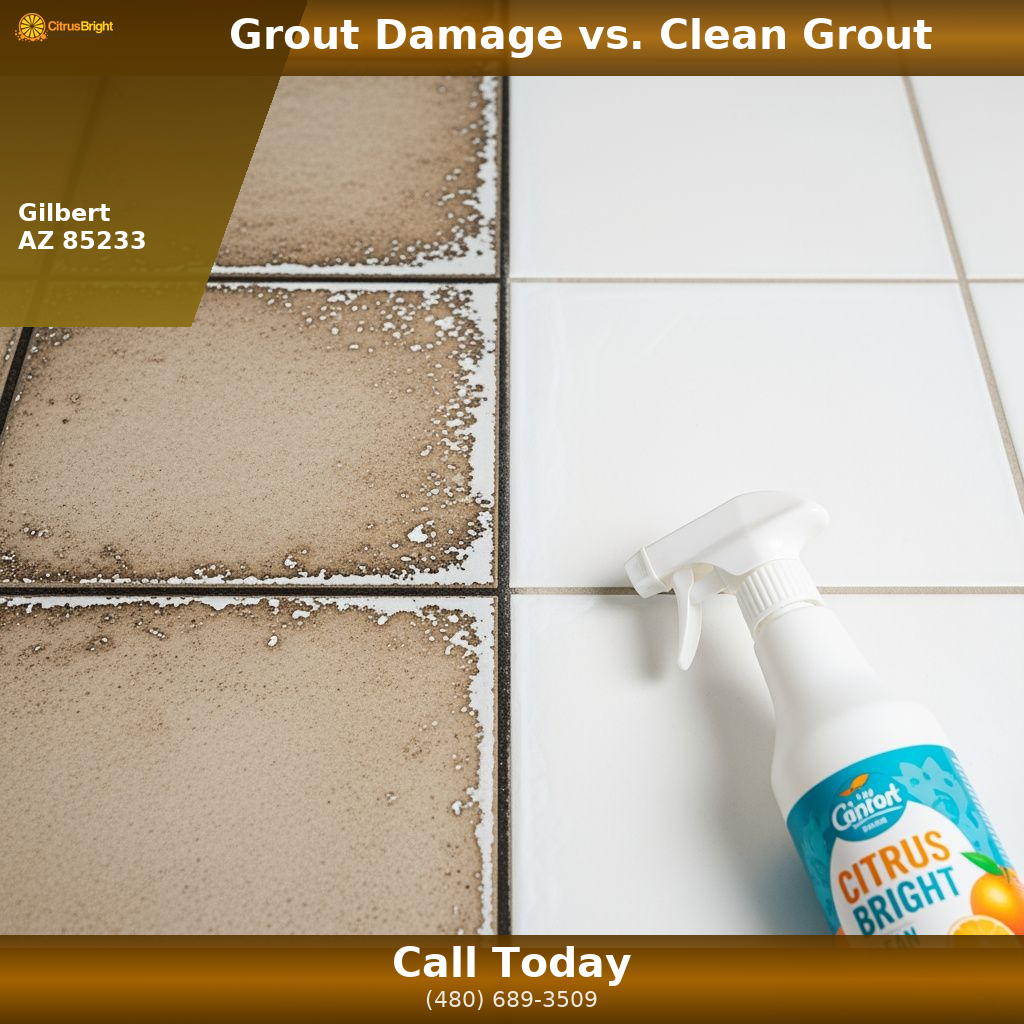
Mineral staining typically appears as a chalky white, gray, or slightly yellowish haze across the grout surface. It may also show as a general darkening if the mineral crust has accumulated enough soil on top of it. If you run your fingernail across a suspect area and feel a slightly grainy or rough texture that wasn’t there when the tile was new, mineral buildup is almost certainly involved.
Soil buildup looks darker and is concentrated in high-traffic paths through the home — hallways, the kitchen work triangle, the entry from the garage. It usually washes away somewhat with heavy scrubbing but returns quickly because the grout surface has been roughened by underlying mineral deposits.
Mold and mildew appear in areas with persistent moisture: bathroom floors, the edges of showers, and areas near the back door. True mold growth is typically darker — greenish, black, or brownish — and often has a slightly raised or fuzzy appearance when viewed closely. It tends to be localized rather than spread uniformly across a large floor area.
In practice, many Gilbert homeowners are dealing with all three issues layered on top of each other, which is one reason a single product from a hardware store rarely produces satisfying results.
Why Mopping Makes Hard Water Buildup Worse
This is the part most homeowners find genuinely surprising: routine mopping with tap water is one of the primary drivers of mineral accumulation in Gilbert homes.
A standard mop distributes water across the floor and then attempts to collect surface-level dirt. However, mops do not extract liquid from pores — they spread it. When you mop with Gilbert tap water, you deposit more dissolved minerals into the grout with each pass. Even mopping with a cleaning solution does not overcome this physical reality. The solution may cut some surface grease, but the immediately following rinse water redeposits minerals.
Furthermore, many popular floor cleaners leave surfactant residue that acts like a magnet for airborne dust and tracked-in soil. The floor may look clean immediately after mopping but dulls within days — which is an experience many Gilbert homeowners describe as deeply demoralizing after years of consistent effort.
What Professional Tile and Grout Cleaning Actually Does
Professional tile and grout cleaning works differently from mopping at a fundamental level — not just in degree, but in method.
A professional system typically uses a pH-appropriate cleaning solution that chemically reacts with and loosens mineral deposits, soil, and biological buildup simultaneously. A citrus-based cleaning system, for example, uses naturally acidic citric compounds to break down calcium carbonate deposits — the same mineral that makes water “hard” — without the harsh fumes of many industrial acid cleaners.
After the solution dwells on the grout surface, a high-pressure hot-water extraction tool passes over the tile. This step is the critical difference: the machine forces clean water into the grout under pressure and then immediately vacuums it back out, pulling dislodged minerals, soil, and cleaning solution residue with it. The water never simply sits in the pores and evaporates.
The practical results for a Gilbert homeowner typically include:
- Visibly lighter and more uniform grout color across the floor
- A cleaner surface that stays cleaner longer because the mineral crust that was trapping soil has been removed
- Removal of biological buildup in damp areas like bathrooms
- A fresh baseline from which a grout sealer can actually bond properly
It is worth being straightforward here: professional cleaning significantly improves grout appearance, but very old or very deeply stained grout may not return to its original installation color. In those cases, grout recoloring or replacement becomes the next conversation. An honest professional will tell you that upfront, rather than guarantee outcomes that the chemistry cannot deliver.
One more point worth understanding: the quality of the rinse water matters in a hard-water market like Gilbert. Professionals who use filtered or softened water during the extraction phase avoid re-depositing minerals back into the grout during the cleaning process itself — a detail that separates a genuinely effective service from one that simply looks good for a week before the dinginess returns.
Frequently Asked Questions about Hard Water Tile Cleaning
Why Trust Citrus Bright
At Citrus Bright, we take pride in delivering exceptional cleaning services for both homes and businesses. What sets us apart? Our commitment to the environment and your well-being. With our unique citrus-based cleaning solutions, we offer a refreshing approach to carpet cleaning, tile and grout cleaning, upholstery treatments, and heavy pet soil areas.
Our citrus-based cleaning technology is a game-changer in the industry. Unlike traditional cleaning agents, our eco-friendly solutions harness the power of citrus to break down dirt, grime, and stains effectively while leaving behind a pleasant, natural fragrance. This innovative approach is not only effective but also reduces the use of harsh chemicals, making it ideal for homes with children, pets, or individuals with sensitivities.
At Citrus Bright, our dedication goes beyond just cleaning; it’s about creating a healthier, more comfortable environment for you and your loved ones. Experience the difference of our citrus-based approach and let us help you maintain a spotless and inviting space.
To book an appointment, contact us at one of our two offices our professional carpet cleaning Queen Creek Location or visit our professional carpet cleaning service in Phoenix. Let us show you the Citrus Bright Difference.
Learn more about our tile and grout cleaning services.